Greater Precision
Robotics assists the surgeon in executing planned movements with high accuracy, especially when placing implants.
In an increasingly technological world, medicine evolves with the implementation of innovative solutions that directly impact patient safety and recovery during surgical procedures.
Robotic spine surgery revolutionized orthopedics by allowing faster, more accurate, and minimally invasive procedures, reducing risks of bleeding, infections, and accelerating rehabilitation.
With the help of advanced robotic systems, it is possible to obtain a highly detailed view of the patient's anatomy, providing greater assertiveness in surgical decisions.
"Count on the expertise of Dr. Nelson Astur, a pioneer in robotic spine surgery in Brazil, and gain access to the most modern resources in medicine."

Spine Surgery
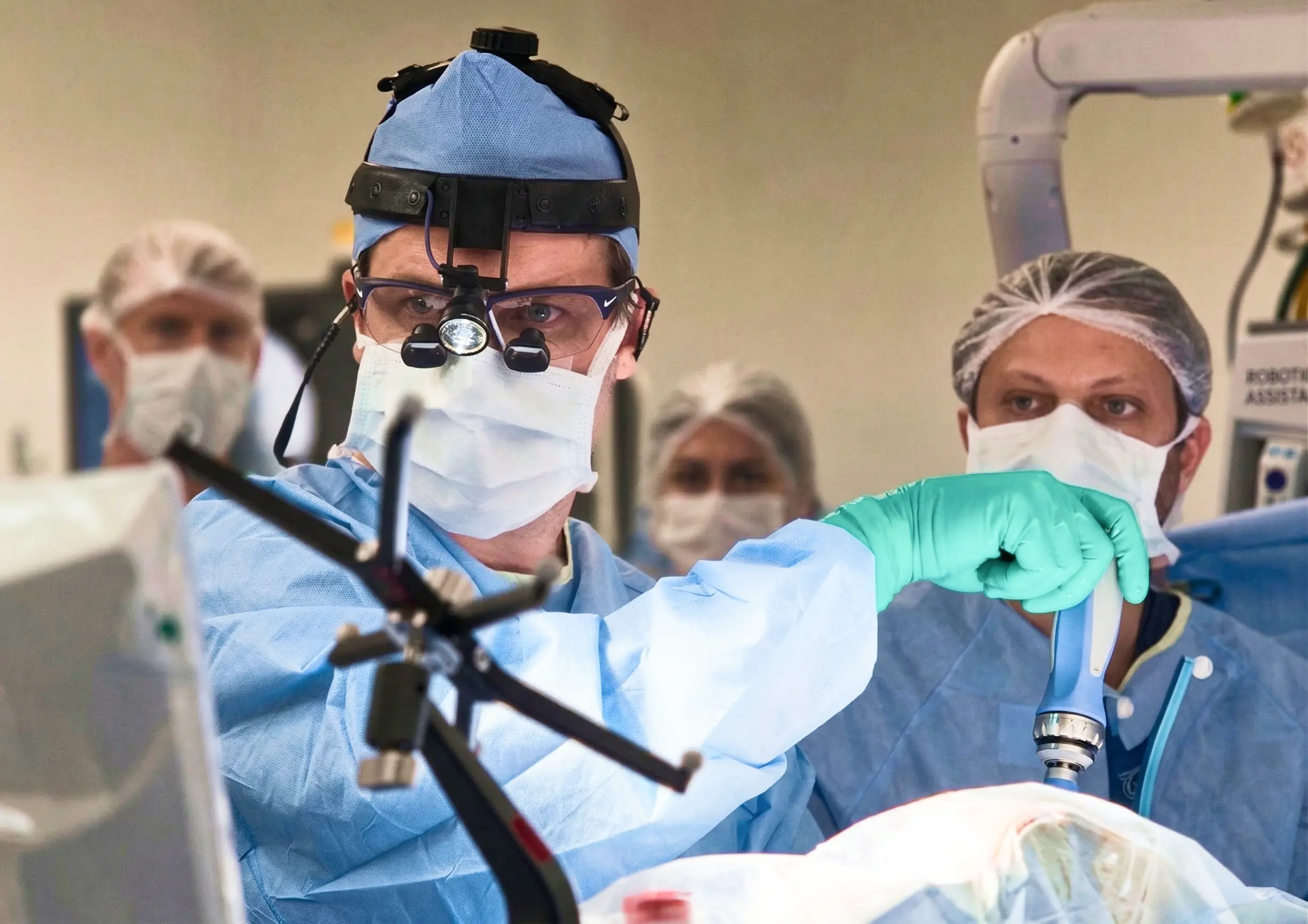

Precision • Safety • 3D Planning
Precision, safety, and technology at the service of spine treatment. Understand how robotics assists the surgeon in procedures planned with 3D images, advanced navigation, and millimetric execution.
The surgeon remains in full control of the entire procedure. Robotic technology operates as a supportive tool, assisting in executing the surgical plan with greater precision and stability.
Three-dimensional planning
Millimetric precision
Surgeon-assisted technology
Robotic spine surgery is an innovative medical approach that uses advanced robotic systems to assist the surgeon during operative procedures. It combines the specialist's expertise with navigation features, three-dimensional imaging, and robotic arms, allowing for a more precise and planned execution.
Unlike techniques performed solely manually or guided by conventional methods, robotics helps reduce the natural instability of the hands and guides implant placement to the exact position planned by the doctor.
The robotic system does not make decisions on its own. It functions under the surgeon's command, following the planning previously established based on the patient's anatomy.
Advanced anatomical visualization
The procedure is planned with the support of three-dimensional images and navigation technologies, allowing a detailed view of the spine anatomy.
The robot does not operate alone
The surgeon controls the system throughout the entire procedure and defines each step of the surgery.
More structural stability
The mechanical arms help execute the planned path, reducing the natural instability of human hands.
Execution according to plan
The technology directs the placement of implants, such as screws, to the exact position planned by the specialist.
The benefits of robotic surgery are related to the union of planning, technology, and medical experience. The indication must always be individualized after assessment by the specialist.
Robotics assists the surgeon in executing planned movements with high accuracy, especially when placing implants.
The use of navigation and three-dimensional images contributes to a more controlled and planned procedure.
The technology can reduce the need for multiple images during surgery, lowering exposure for the patient and team.
By allowing more precise and less invasive approaches, it can reduce damage to tissues near the spine.
With less aggression to tissues, the patient may experience less pain and a more comfortable recovery.
In many cases, the technology can favor a faster resumption of mobility, always according to medical guidance.
According to analyzed content, the technology can be considered primarily in spine surgeries involving the placement of implants, such as screws.
Herniated discs
Spinal stenosis
Vertebral fractures
Scoliosis and spinal deformities
General degenerative spinal diseases
Lumbar spine arthrodesis
Arthrodese revision surgeries
Posterior cervical arthrodesis
The decision depends on an individualized evaluation, exams, medical diagnosis, and guidance from the specialist.
Spine Surgery • Robotic Technology
Dr. Nelson Astur Neto works in treating spinal diseases and presents robotic surgery as a technology that unites innovation, planning, and precision to assist the surgeon in complex procedures.
Spinal treatments with an individualized approach and focus on careful evaluation of each patient.
Use of modern resources for planning, navigation, and robotic assistance in spine surgery.
Robotic surgery is not automatically indicated for all cases. The patient must undergo evaluation with the specialist to understand if this technology makes sense for their condition.
Recovery time depends on the complexity of the procedure, prior health status, and each patient's individual response.
After surgery, the patient must follow medical recommendations, avoid strain, maintain good posture, and perform physical therapy when indicated.
Only a specialized evaluation can determine if robotic surgery is suitable for the diagnosis and treatment goals.
No. The robot does not operate alone. The spine surgeon controls the entire system. The technology acts as a supportive tool to execute planning with more precision.
It is a surgical approach that utilizes robotic systems, three-dimensional imaging, and navigation technology to assist the surgeon during spinal procedures.
Among the cited benefits are greater precision, less instability during implant placement, lower radiation exposure, less surgical trauma, and the possibility of a smoother recovery.
Recovery can be optimized in many cases, but it varies according to the complexity of the surgery, the patient's health status, and adherence to post-operative medical guidelines.
It can be considered in spine surgeries requiring implants, such as herniated discs, spinal stenosis, fractures, scoliosis, degenerative diseases, and fusions.
Not necessarily. The indication must be individualized after evaluation with a spine surgeon, considering the diagnosis, exams, and clinical conditions of the patient.
Schedule an evaluation with Dr. Nelson Astur Neto and talk to a specialist about your diagnosis, exams, and treatment possibilities for the spine.
This content is for informational purposes and does not replace medical consultation. The indication for any treatment must be made after an individualized evaluation.